

Sweden Travel Log
Updated: Jul 22
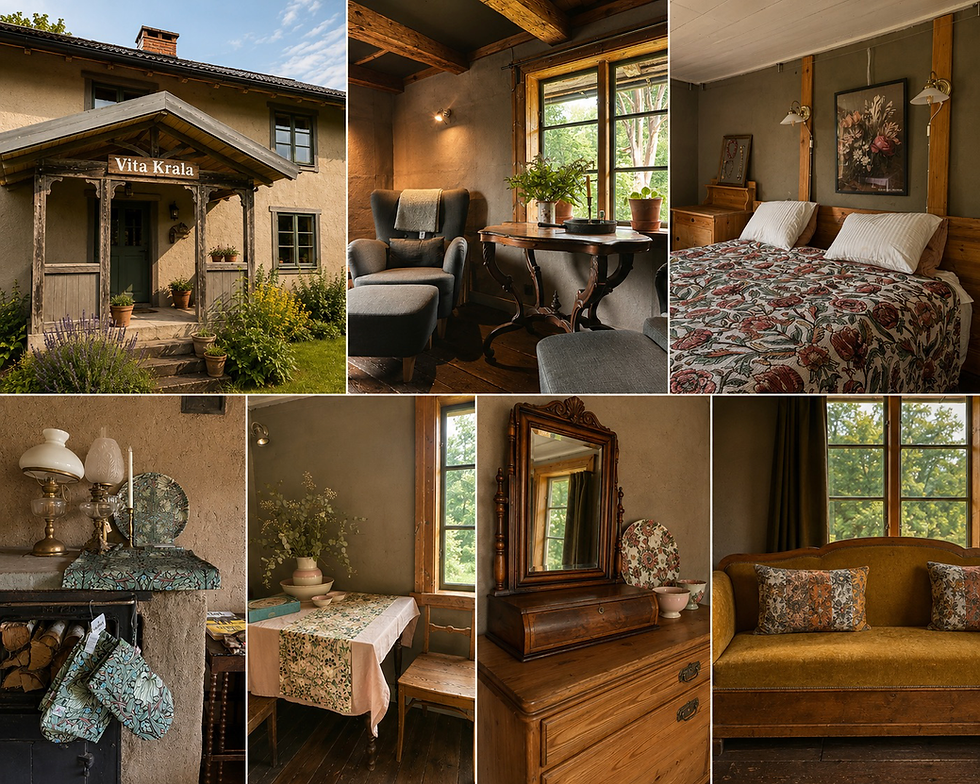
It has been ten days since I arrived at Vita Krala, and I am exhausted—in the very best way.
Keeping pace with Chris, the owner, is a feat of endurance. Today marked the culmination of our first major milestone: the market, an annual local festival complete with games, food, a bouncy house, and vendors selling goods from around the region.
Chris has been on a marmalade-making marathon since I arrived, preparing preserves for the big day. Friday, we drove all over the area collecting beautiful produce, sourdough bread and other goods from small local producers to fill the Vita Krala market table.

My original assignment was to create new labels for the preserves, liqueurs, vinegars, and local honey.
Of course, I am not particularly skilled at doing anything halfway, so a simple label project quickly sparked an entire rebrand for the business.

Naturally, I had to begin with a new logo, creating visual elements we could then carry across the labels, website, signage, and social media. Chris also needed each label to include a QR code linking to a page on the Vita Krala website containing the recipe and ingredient information required under local regulations.
We were not planning to rebuild the website just yet. The immediate push was simply to finish the labels, which was already a challenging deadline.
The website will now be finished before I leave.

From Farm Volunteer to Unpaid Business Partner
I arrived here as a volunteer farm worker through WWOOF and was quickly promoted to business partner—still receiving volunteer pay, naturally.
Fortunately, the compensation package includes unlimited beautiful food, a peaceful natural setting, and the opportunity to meet the lovely guests who pass through Vita Krala.
Within my first week, I was placed in charge of the social media, branding, photography, and floral design for the guesthouse, restaurant, and garden boutique.
It feels familiar to step into a place, see its potential, and begin connecting all the pieces. The brand, the property, the food, the story, and the guest experience are all part of the same ecosystem.
Discovering the Swedish Art of Loppis
Chris has also treated me to more than one day of loppis shopping, the Swedish name for secondhand shops and flea markets.
I have to admit: Sweden’s loppis game is impressive.
It is something between an antique store and a thrift shop, with prices generally falling somewhere in the middle. Many of the secondhand shops feel more like carefully curated boutiques, with organized racks of clothing, beautiful home goods, ironed textiles, vintage dishes, furniture, and unexpected treasures.


They contain all the things you might find at a local thrift store in the United States, but presented in settings that are often far more thoughtful and beautiful.
The Day After Monday
Our regular shopping days are “the day after Monday”—Chris’s way of remembering the difference between Tuesday and Thursday—and Friday.
Chris speaks four languages fluently, so I think she is allowed to invent her own system for remembering the days of the week.
On these outings, we provision the restaurant with ingredients from the best local producers we can find, along with organic items from the grocery store.
The truth is that people in Sweden do not seem to be nearly as concerned about everything being certified organic as I expected. There is also plenty of processed food in the grocery stores, although many products appear to contain fewer additives than their American equivalents.

That makes Chris’s dedication to sourcing organic food even more commendable. It is not simply a marketing phrase for her. It is a genuine commitment that requires additional time, driving, planning, and expense.
Why Sweden?
Before coming here, I did not fully understand what was calling me to Sweden.
Since arriving, I have learned that I have Swedish roots through my mother’s maternal lineage. I have also experienced a strong spiritual recognition of this country and the sense that I have lived here before in a parallel reality or "past life".
To say that I feel at home here is an understatement.
There is something about the landscape, the old houses, the forests, the lakes, and the pace of rural life that feels deeply familiar.
At the same time, this experience is helping me understand what I do—and do not—want to create next.
I Do Not Want to Run Another Guesthouse
One thing has become very clear: I am not looking to personally operate another traditional guesthouse.
The long hours and low financial return are not something I want to revisit after my Hona Wellness Guest House project in Costa Rica closed during CONVID.
Hospitality is beautiful work, but it is relentless. There is always another room to prepare, another meal to cook, another guest arriving, and another problem that needs immediate attention.
What I am beginning to see instead is that there are already many remarkable places like Vita Krala that could be ideal for the kind of restorative wellness experience Sanctuary is focused on creating.
I am seeing the emergence of Sanctuary Stays: a curated collection of wellness stays hosted at properties that are already operating.
These locations could range from simple farm stays and Harvest Host properties to boutique guesthouses, retreat centers, and full-scale resorts.
Rather than building and operating every sanctuary ourselves, we could help beautiful existing properties become places where people can genuinely rest, regulate their nervous systems, reconnect with nature, and return to themselves.
Vita Krala as a Sanctuary Stay
Vita Krala is a perfect example.
It is an ideal location for a digital detox and nervous system reset, with ample opportunities for forest bathing, birdwatching, quiet walks, and time beside the beautiful lakes surrounding the property.
The restaurant offers farm-to-table, organic nourishment prepared with extraordinary care and love. The guesthouse is peaceful and personal, and the entire experience is overseen by Chris, who has the spirit of a true mama.
These are the environments where people can begin to restore their health—not through constant treatment or stimulation, but through rest, nourishment, nature, beauty, and being cared for.
A Sanctuary Wellness Stay at Vita Krala could last anywhere from one week to three months. Guests could step away from the demands of everyday life and be supported as they reconnect with their own natural rhythm.
For the guest, it creates the time and environment necessary for genuine restoration.
For Chris and Vita Krala, it could mean longer stays, less guest turnover, stronger occupancy, and more predictable revenue—all important hospitality performance indicators.
Chris is very open to the idea, and from both a business and marketing perspective, I see significant potential for the property.
A Different Role for Me
I am finally taking a few days away and heading to Stockholm to experience the city and ponder this emerging direction.
This trip is showing me that I may be more valuable helping existing hospitality businesses expand into the wellness market than trying to start, own, and operate a single property myself.
That realization also gives me a different perspective on the Riggins Hot Springs property I have recently been exploring as a possible wellness retreat.
Perhaps my role is not simply to operate one location.
Perhaps it is to recognize the sanctuaries that already exist, help their owners understand what they are holding, and create a trusted network of places where people can go to heal, rest, reconnect, and remember who they are.
For now, I am heading to Stockholm with tired feet, a full heart, and a great deal to think about.
Follow the Journey
Vita KralaWebsite: www.vitakrala.com
Instagram: https://www.instagram.com/vitakrala
Facebook: https://www.facebook.com/vitakrala


Comments