

From Eco Coins to Conservation Land: Why RWA Tokenization Matters

Updated: Jul 22
Back in 2020, I went deep into crypto.
Not just buying coins or watching charts. I learned how to invest, studied the technology, and even volunteered for an emerging eco coin project called SEEDS. At the time, it felt like something new was being born: a currency rooted not only in speculation, but in ecology, community, and a better way of organizing value.
Unfortunately, SEEDS became what many would now call a conscious rug pull. The promise was broken.
But one thing stayed with me.
People really wanted it to work.
They wanted an eco coin. They wanted a regenerative economy. They wanted money to be connected to something real, something living, something that could restore rather than extract.
The part that intrigued me most was the idea of using land as an asset to back value. For years, one of the biggest criticisms of crypto has been that it has “no real value” behind it. Coins could go up or down based on hype, attention, and market psychology, but what was underneath them?
Now, with the rise of real-world asset tokenization, that question is beginning to change.
Real-world asset tokenization, often called RWA tokenization, is the process of taking something that exists in the physical or traditional financial world — real estate, land, commodities, bonds, income-producing assets — and representing ownership or economic rights to that asset through digital tokens on a blockchain.
In simple terms, the asset does not disappear into the blockchain. The land is still land. The building is still a building. The conservation parcel is still soil, water, trees, habitat, and sacred space.
What changes is the way participation, ownership, income, and stewardship can be structured.
A recent Forbes article, “How Real Estate Tokenization Opens New Paths For Ownership And Income,” explains how tokenized real estate works. A property is placed into a legal structure. Ownership rights or income rights are divided into digital tokens. Those tokens can then represent fractional claims in the asset, and in some cases smart contracts can automate distributions to token holders.
This is very different from the early days of crypto, when so many projects were selling a vision without a true asset underneath it.
With tokenized real-world assets, the promise is not simply, “Believe in this coin.”
The promise becomes, “Here is the underlying asset. Here is the legal structure. Here is the ownership or income right. Here is the record. Here is how distributions happen. Here is how the value is connected to something real.”
That is why mainstream financial companies are now paying attention. Deloitte has projected that tokenized real estate could grow from less than $300 billion in 2024 to more than $4 trillion by 2035. Large real estate firms are also beginning to explore tokenization as a way to increase liquidity, broaden access, and modernize ownership structures.
But for me, the most exciting application is not luxury apartments or commercial towers.
It is conservation land.
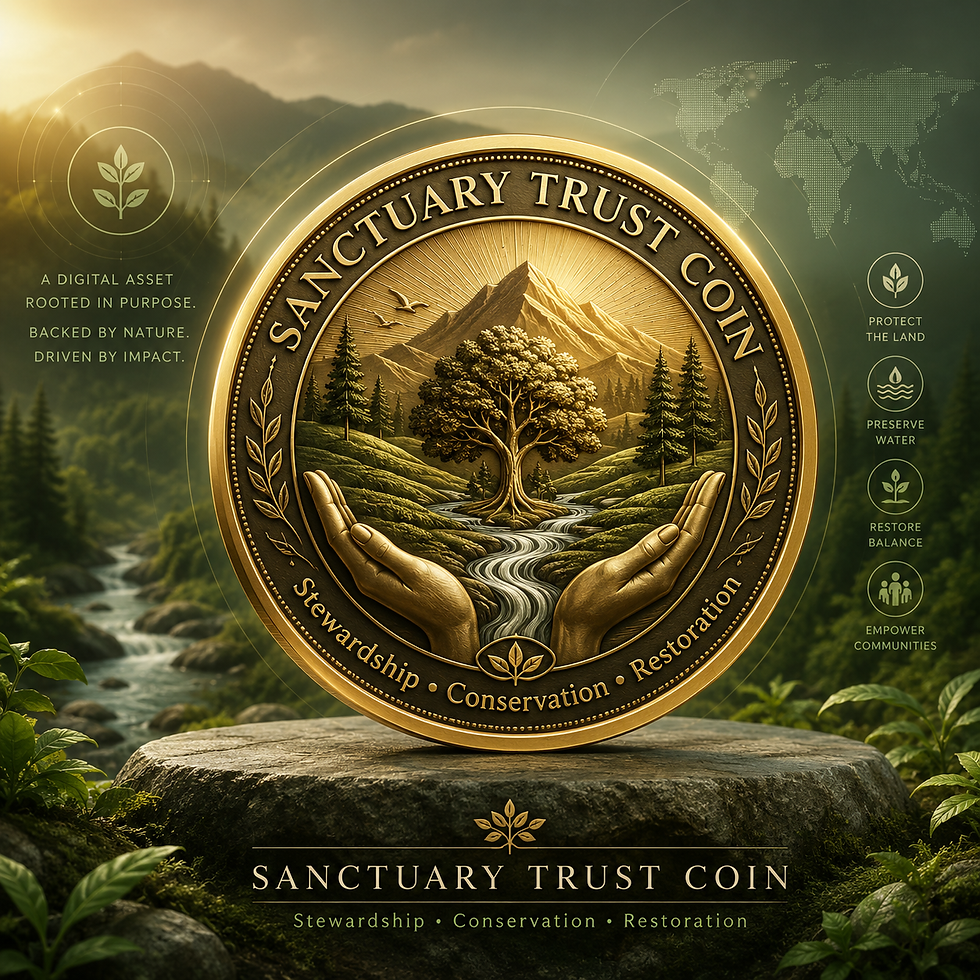
Ultimately, I want to explore how conservation land held in Sanctuary Trust could be tokenized in a way that grows the mission while protecting the land itself.
That distinction matters.
This would not be about chopping sacred land into speculative pieces and selling it off to the highest bidder. It would not be about turning nature into another casino. It would have to be structured with deep care, proper legal guidance, and strong spiritual and ecological boundaries.
The vision is different.
Imagine conservation land held in trust, protected by mission, covenant, and legal structure. The land remains whole. The trust remains steward. The purpose remains restoration, prayer, fasting, healing, nature immersion, clean water, habitat protection, and community benefit.
Then imagine a tokenized structure that allows supporters to participate in the mission.
Depending on the legal model, tokens could potentially represent membership interests, revenue participation, conservation-support shares, project funding rights, or other carefully designed economic interests. They could help fund land acquisition, water restoration, retreat infrastructure, food forests, healing spaces, wildlife corridors, or debt-free stewardship.
In a simple example, Sanctuary Trust could hold a piece of conservation land. A separate legal entity could be created for a specific project connected to that land, such as a retreat cabin, food forest, education center, or restoration project. Tokens could represent a fractional economic interest in that project, not ownership that allows someone to control or exploit the land. If the project generated revenue through retreats, stays, education, or regenerative agriculture, distributions could potentially be made according to the terms of the offering.
The blockchain would not replace law. It would not replace stewardship. It would not replace trust.
It would simply become a transparent record and distribution system.
This is where the conversation has matured. The serious people in the RWA space are clear that a token by itself does not create value. The real value comes from the underlying asset, the legal structure, the rights attached to the token, the quality of management, and the integrity of the mission.
In real estate, the fundamentals still matter: title, cash flow, location, occupancy, maintenance, debt, and legal compliance.
In conservation land, the fundamentals would also matter: clean title, ecological value, water rights, access, zoning, conservation restrictions, trust governance, long-term stewardship, and the spiritual integrity of the mission.
This is why I believe the next era of crypto will not be about hype coins. It will be about whether we can use blockchain tools to bring more transparency, accountability, and participation to real-world stewardship.
For years, people have wanted a regenerative economy. They wanted money connected to land, food, water, community, and healing. The first wave of eco coins showed that the desire was real, even when many of the projects failed to deliver.
RWA tokenization may be the bridge between that original dream and a more mature reality.
It gives us a way to ask better questions:
Can land be protected and still become part of a living economy?
Can supporters participate in conservation without forcing the land into extraction?
Can sacred spaces be funded without selling out their purpose?
Can financial tools serve restoration instead of speculation?
Can ownership become stewardship?
I do not believe tokenization is automatically good. Like any tool, it can be used to exploit or to restore. It can become another layer of financialization, or it can become a new pathway for mission-aligned participation.
The difference will be the structure, the intention, and the people stewarding it.
For Sanctuary Trust, the dream is not simply to create a token.
The dream is to protect land, restore water, create places of healing, and build a model where those who believe in the mission can help it grow.
Maybe this is what the early eco coins were reaching for before the space was mature enough to hold it.
Maybe the technology is finally catching up to the vision.
And maybe the next chapter of conservation will not only be donation-based or government-grant dependent.
Maybe it will be asset-backed, transparent, mission-governed, and rooted in the land itself.


Comments